
Manipulatives
An ability to solve facts really fast only goes so far until you’re asked to make meaning of what you memorized or apply it to a new concept, which you will definitely be asked. “How can I use 4 x 7 to solve 8 x 7?” I’d be stumped if I was back in 4th grade I’d say “4 x 7 just is 28 and 8 x 7 just is 56”. What I should be able to say is “4 x 7 is like 4 groups of 7 and so if I double the number of groups of 7 to 8 groups, the answer also doubles, so 28 doubled is 56.”Efficiency doesn’t just come from memorizing, it comes from understanding how numbers relate readily and quickly calculating because of those learned connections.
Mad minutes were a traditional way of developing fact “fluency”, but there is a reason teachers don’t use them anymore. They left out a key part: how are numbers related? Number sense is a significant part of developing math “genius” and should not be overlooked.
This added layer to fact fluency can feel insignificant and frustrating when a child needs to just learn that 3 + 7 = 10 so they don’t take hours to do their homework. However, if they are not learning why 3 + 7 = 10 at the same time of recognizing it, they will have a much harder time making connections in later grades. Children can not make sense of math after it has already been taught to them. Rather, it needs to be taught simultaneously and that’s called fact fluency.
How can you help them learn this? Ask questions that make your child THINK and reflect. If your child can answer the question“How can I use 4 x 7 to solve 8 x 7?”with an answer that demonstrates number sense, that’s great and keep ecnouraging that! If they have a hard time answering the question, take it as a learning opportunity to teach them the connection. They may not make the connection after one time and so you should continue to have the same conversations. Repeated exposure and time to think is vital to your child’s fact fluency development.
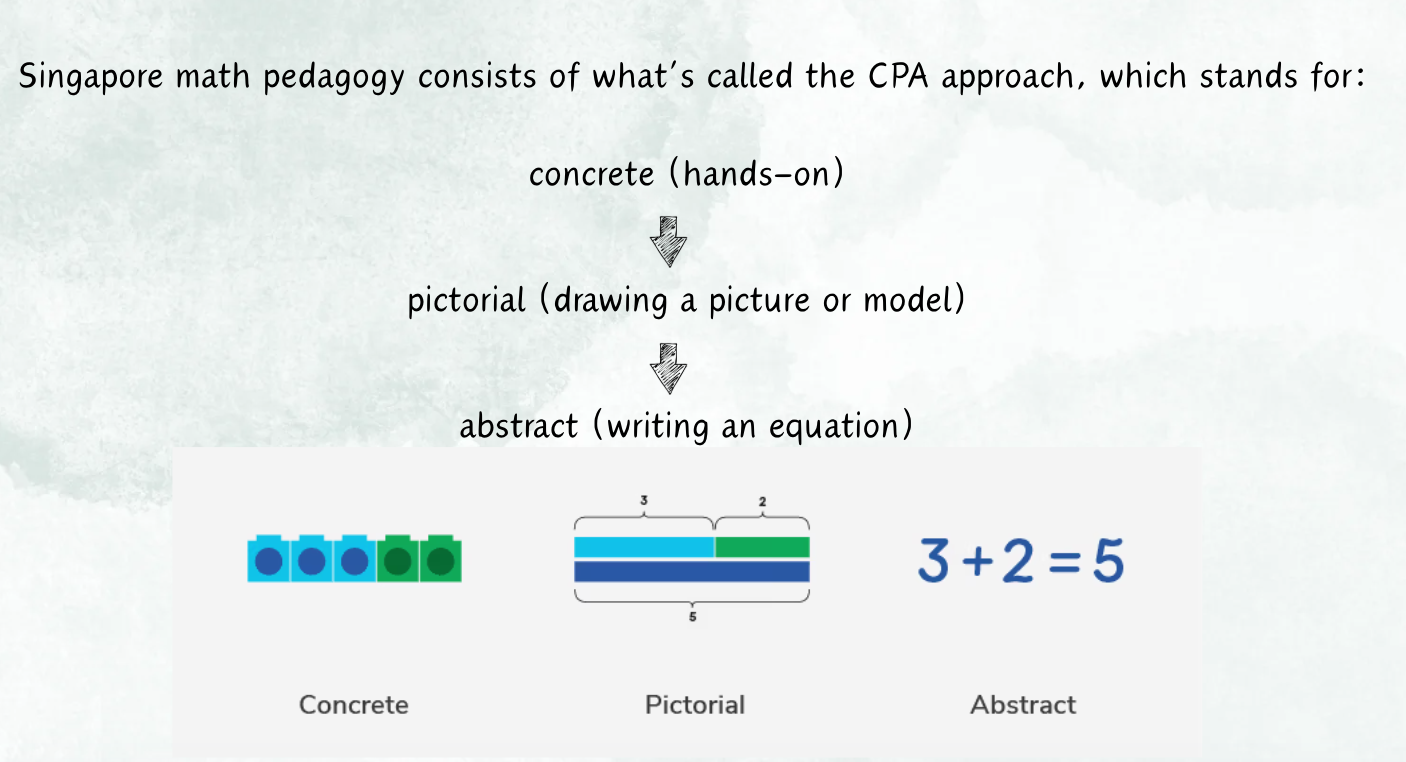
Concrete-Pictorial-Abstract Approach
If math is taught with this framework, students are more likely to acquire new information. Starting with a concrete representation involves manipulatives and hands-on learning experiences. Cubes, place value blocks, tiles, fraction pieces are all examples of common manipulatives that are used in math lessons. When students have mastered the concrete, you can progress them to the pictorial representations of the concept, and then finally to an abstract form.
Often times educators and parents may introduce manipulatives only when students first get introduced to a topic at the pictorial or abstract stage of the CPA approach. When we do backtrack to the concrete, we find the student/child is able to grasp the concept more strongly. Wouldn’t this suggest that this is where we should be starting always? YES it does, which is why the CPA approach is so important to follow no matter how old the child is in elementary education. We should not be skipping the manipulative stage because it feels “baby-ish”for certain ages or because kids shouldn’t need them anymore. Yes children do progress in their ability to recognize information in abstract ways, however the truth is that our brains benefit from seeing information multiple ways throughout our lives and hands-on learning is always engaging and often preferred.
Using concrete materials to learn is proven to be the most developmental appropriate strategy for children when they first learn a math concept. Brains cannot immediately make sense of pictorial and abstract concepts at a young age, that’s why manipulatives are needed.
Using manipulatives from the beginning allows us to meet kids where they are. Manipulatives are universal, versatile, and flexible in their use which makes them excellent concrete materials. For example, tiles can be used to teach area and perimeter or they can be used as a measuring tool or they can be used to create shape patterns. It is important to use manipulatives intentionally and purposefully so that they carry meaning for the child.
How can you support your children with using manipulatives at home?
Ask your student’s teacher if they can borrow a set of tiles or cubes for the homework
Look on amazon for common materials, manipulatives are universal and can be purchased easily
Make your own manipulatives - it can be a purposeful activity with your child
