Part-Part-Whole
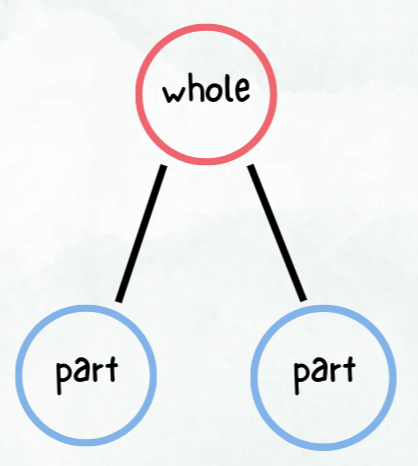
The concept of part-part-whole is a newer way to refer to numbers and values in problems using the four operations. As a concept, it is broad in scope and can be applied to multiple contexts. As children begin to learn about numbers they are introduced to the parts that make up the whole number. Using part-part-whole language is beneficial in supporting students’ flexible thinking and development of number sense. It generalizes a number to a context that is interchangeable in fact families. Take a look —> at how “parts” and “wholes” are related without using number values.
Whole - two+ parts make a whole, a number
Part - a piece of the whole, a number
Number bonds are a visual used to demonstrate part-part-whole relationships for addition and subtraction problems
***This relationship can be used for any number of parts making up a whole (example: 3 addends)**
This model is used almost universally and is language you should use with your child because it also builds number flexibility for your children when learning fact families and how different numbers are related to each other in multiple ways.
Addition & subtraction fact family
part 1 + part 2 = whole
part 2 + part 1 = whole
whole - part 1 = part 2
whole - part 2 = part 1
Multiplication & division fact family
part 1 x part 2 = whole
part 2 x part 1 = whole
whole ÷ part 1 = part 2
whole ÷ part 2 = part 1