
What is the problem?
In my teaching career, I have had many conversations with colleagues, parents, and friends about how “different” math is today compared to when we were in school. A lot of these conversations have been accompanied by frustration, anxiety, tears, and questioning. A question that particularly stands out to me from parents is:
“I don’t get the math now. Why can’t they just learn the way I learned? It’s so much more complicated now.”
Math curriculum has evolved greatly over the last decade. While it may feel challenging to keep up and understand the changes that have occurred, there is logical reason behind the changes and they are worth learning about.
The Epidemic
As parents and educators we are seeing an epidemic of math anxiety and helplessness among children. In our society today, there is a desire for immediate satisfaction and satiation that results from minimal effort.
Students are approaching math with negative mindsets, fear, low self-efficacy, are unwilling to think hard, and are unmotivated to persevere through problems
Parents are feeling unsuccessful and incapable of helping their children with their homework, working with their children because it takes too much time, and providing positive feedback to their children
WE HAVE TO REMIND OURSELVES AND OUR KIDS THAT THINKING IS VALUABLE AND THE KEY TO SUCCESS.
Dilemma
While we can identify that we have an epidemic, there is a dilemma that is an obstacle in the way of overcoming it. That dilemma is that parents are teaching their children the math that they learned as kids, which is not aligned with what schools are teaching resulting in a learning block and a lot of tears. Parents have to understand that you are NOT helping your child when you do this. Kids need consistency with method and vocabulary across all environments. This is hard for you to do when you don’t know what is being taught in school.
This misalignment is particularly a result of interfering too much during homework time. Homework for many has become a time of major frustration instead of serving as a light reinforcer outside of school. There is a wide range of parent involvement in children’s homework. It is important not to interfere with a child’s ability to think for themselves and reflect on what they learned in school. Parents, though, also shouldn’t feel like they can’t help their children if they have a question.
It is no wonder why we have this epidemic of anxiety when we all are on different pages with respect to how math should be learned.
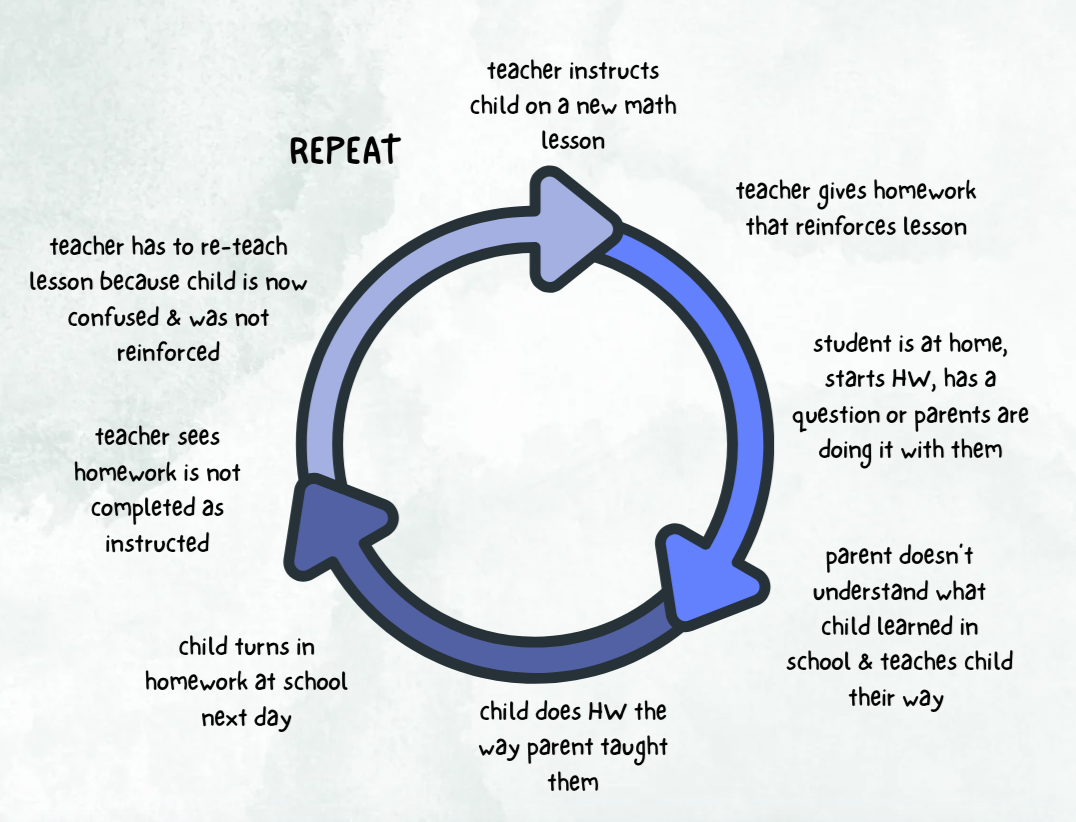
This is the cycle that we are stuck in and are unable to get out of unless parents and educators work together.
The Reality
“New math” has been around for several years now and isn’t stopping anytime soon, and what I continue to see and hear is that most parents still don’t know what we are teaching as educators and are not even given the education on what we are teaching. The fact of the matter is that “new math” is not actually “new”. It is actually a revisit to foundations that were being taught when we were in school and the act of backtracking to fill in gaps that are known to exist as children get older and reach higher education.
As an educator, I will not be successful without the partnership with parents and so this issue that perpetuates has driven me to do something about bridging this gap. I hope you will join me on this journey.
